

By Marisol Vega · Research Writer
Published · Updated
Answer in brief
For insurance purposes the labels are interchangeable. DUI, DWI, OWI, OUI and DUAC are the terms different states use for impaired-driving convictions, and insurers rate them in the same major-violation category. What changes the rating is the type of conviction on the record: a standard impaired-driving conviction, a reduced charge such as wet reckless, or an aggravated or felony conviction. A reduced charge is usually rated less severely, but many insurers still treat an alcohol-related reckless driving conviction as a major violation.
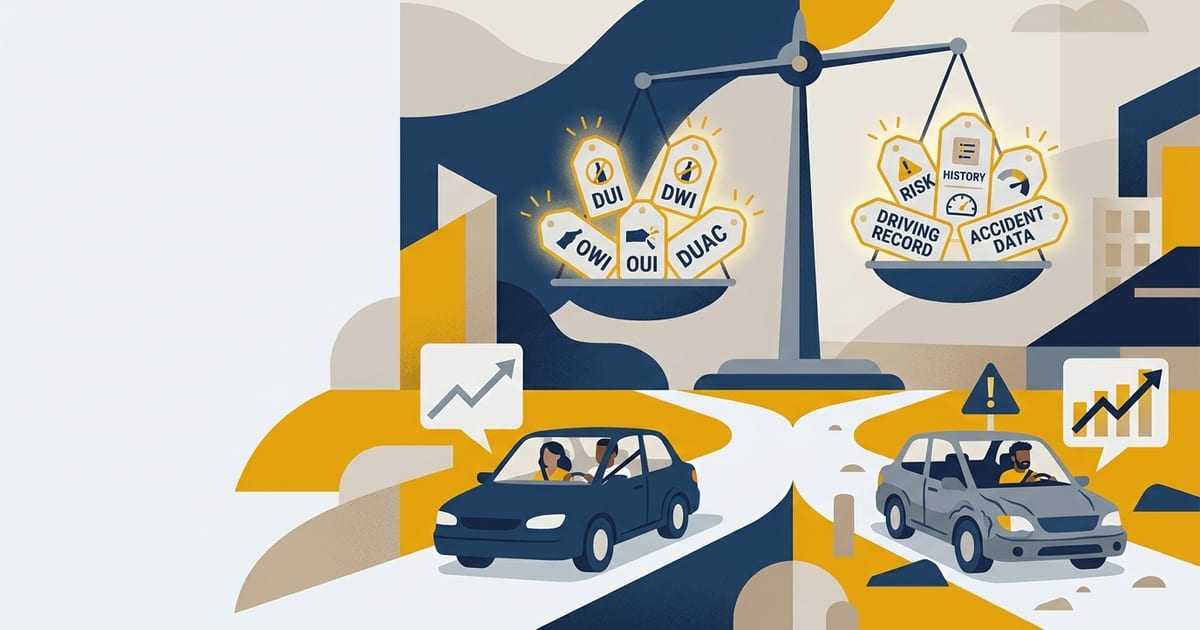
The labels and where they are used
| Term | Stands for | Typical states |
|---|---|---|
| DUI | Driving Under the Influence | Most states, including California, Florida, Georgia, Illinois |
| DWI | Driving While Intoxicated / Impaired | Texas, New York, Missouri, Minnesota, North Carolina, New Jersey |
| OWI | Operating While Intoxicated | Michigan, Wisconsin, Iowa, Indiana |
| OUI | Operating Under the Influence | Massachusetts, Maine |
| DUAC | Driving with an Unlawful Alcohol Concentration | South Carolina |
| DWAI | Driving While Ability Impaired (lesser offense) | New York, Colorado |
Some states use two terms to distinguish severity—New York's DWAI is a lesser offense than DWI, for example—and that distinction can matter for insurance. The name alone does not.
How insurers classify convictions
Rating systems group violations into categories: minor moving violations, major violations and, in some systems, a separate class for alcohol or drug-related offenses. An impaired-driving conviction, whatever the state calls it, lands in the most serious category. The insurer reads the conviction code on your record, not the acronym, and maps it to its own category. Two drivers with a DWI in Texas and a DUI in Georgia are rated the same way by the same insurer, all else equal.
Wet reckless and other reduced charges
In some states a DUI charge can be reduced by plea to reckless driving with alcohol involvement, informally called a wet reckless, or to a lesser impairment offense like DWAI. For insurance this is better than a DUI—but how much better varies. Many insurers rate any alcohol-related conviction as a major violation; others rate reckless driving as a major violation and do not distinguish the alcohol element; a few rate it as a lesser offense. The filing requirement is often avoided or shortened with a reduced charge, which is a real saving. If you are weighing a plea, the insurance effect is one input; an attorney should be the other.
Aggravating factors
A conviction with aggravating factors—very high BAC, a minor in the vehicle, injury, refusal to test, or a prior conviction—may be recorded under a different code and rated more severely. Felony impaired-driving convictions are rated most severely and may be declined by more insurers. The practical consequence is that the comparison set of willing insurers shrinks, which makes a wide search more important, not less.
Quote finder
Find auto insurance quotes that fit your situation
Drug-related impairment
Most state statutes and most insurer rating categories treat impairment by drugs (including cannabis and prescription medication) the same as alcohol impairment. A conviction for driving under the influence of drugs is rated as a DUI.
Questions & answers
Is a DWI worse than a DUI for insurance?
No. They are different state terms for the same category of offense and are rated the same way.
Will a wet reckless keep my insurance from going up?
It will usually go up less than with a DUI and you may avoid a filing requirement, but many insurers still rate an alcohol-related reckless driving conviction as a major violation.
Does a DWAI in New York or Colorado count as a DUI for insurance?
It is a lesser offense and is often rated less severely, but it remains an alcohol-related violation on your record and will affect your premium.
Terms used in this guide
- DUI (Driving Under the Influence)
- A conviction for operating a vehicle while impaired by alcohol or drugs. For insurance rating it is treated as a major violation regardless of the state's label.
- DWI (Driving While Intoxicated)
- The term several states, including Texas and New York, use for an impaired-driving conviction. Rated identically to a DUI by insurers.
- Wet reckless
- An informal name for a reckless-driving conviction that notes alcohol involvement, often the result of a plea reduced from a DUI charge. Usually rated less severely than a DUI, but many insurers still treat it as a major violation.
- High-risk driver
- An insurer's classification for a driver whose record—typically a DUI, multiple violations, at-fault accidents or a coverage lapse—predicts above-average claim costs. High-risk drivers are rated in a higher tier or placed with non-standard insurers.
Sources and references
Legal figures on this page (minimum limits, filing periods, statutory benefits) are checked against the primary law or the state insurance regulator listed below. Links and figures last verified Nov 2026.
- Fla. Stat. § 324.023 — financial responsibility after a DUI conviction — Florida Legislature (Online Sunshine), Fla. Stat. § 324.023Primary lawAfter a DUI conviction (since 1 Oct 2007): $100,000 per person / $300,000 per crash bodily injury and $50,000 property damage, maintained for three years from reinstatement — the FR-44 requirement.
- Va. Code § 46.2-316 — proof of financial responsibility after certain convictions — Virginia Law (LIS), Va. Code § 46.2-316(C)Primary lawAfter DUI-type convictions, proof must be at double the § 46.2-472 limits (the FR-44 requirement, currently 100/200/50) for three years after becoming eligible for a licence.
- Insurance Code § 1861.025 — Good Driver Discount eligibility — California Legislative Information, Cal. Ins. Code § 1861.025Primary lawQualified if licensed for the previous three years, no more than one violation point, not principally at fault in an injury or fatal crash, and no DUI-type conviction in the prior ten years.
- Alcohol and drugs — Insurance Institute for Highway SafetyIndependent researchImpaired-driving crash risk, BAC laws and ignition-interlock effectiveness.
- Facts + Statistics: Alcohol-impaired driving — Insurance Information InstituteStatistical dataAlcohol-impaired crash fatalities, BAC thresholds and state ignition-interlock context.
- Responsibility.org — Foundation for Advancing Alcohol ResponsibilityConsumer guidanceImpaired-driving data and prevention programmes; state DUI law summaries.
- What determines the price of an auto insurance policy? — Insurance Information InstituteConsumer guidanceRating factors: driving record, mileage, location, age, gender, vehicle, credit-based insurance score, coverage choices. Notes ZIP-code rating is prohibited in California and Michigan and gender rating is prohibited in seven states.
Practical guidance on this page is original editorial work. Cited sources support factual statements and do not endorse this site. Dollar ranges described as typical or illustrative are editorial estimates, not figures from these sources.
Guide
Car Insurance After a First DUI Offense
The sequence after a first DUI: when to tell your insurer, whether to wait for renewal, what filings apply, and how to avoid the mistakes that make it worse.
Guide
How Much Car Insurance Goes Up After a DUI
Typical premium increases after a DUI, why the range is so wide, and how to tell whether your renewal quote is in the normal band.
Guide
DUI Car Insurance Rules by State
Which states require an SR-22 or FR-44 after a DUI, how long the filing lasts, which states have no filing requirement, and where lookback periods are longest.