
Guide
How to Shop for Car Insurance After a DUI
A step-by-step method for comparing car insurance quotes after a DUI: what to have ready, which questions to ask, how to compare like with like, and when to switch.

By Daniel Okafor · Senior Editor
Published · Updated
Answer in brief
Comparing quotes is the single most effective thing a driver can do after a DUI, because insurers disagree more about how to price a conviction than about almost anything else. The method: gather your documents, state the DUI and any filing requirement up front, request identical coverage from at least three providers (ideally including non-standard specialists), compare total annual cost including fees, and switch only when the new policy and filing are confirmed active. Repeat at the three- and five-year marks.
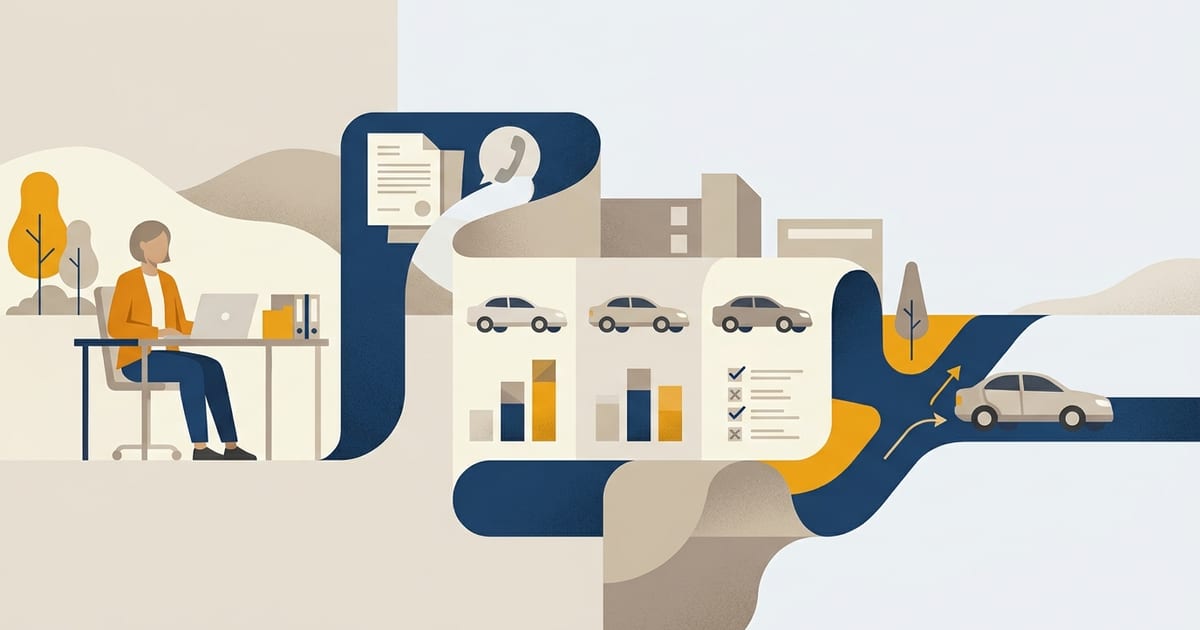
Why shopping matters more after a DUI
For a clean-record driver, the spread between the cheapest and most expensive quote for identical coverage is meaningful but bounded. After a DUI it widens dramatically. Some insurers decline the risk outright; some accept it with a steep surcharge; non-standard specialists build their business on it and price it more moderately. Published comparisons for a single-DUI driver routinely show the highest quote at two to three times the lowest. That gap is money you keep or give away depending on whether you compare.
What to have ready
- Driver's licence numbers for everyone in the household, and the reinstatement notice if your licence was suspended.
- The court or state notice specifying SR-22 or FR-44, required limits and duration.
- Vehicle identification numbers, current mileage and estimated annual mileage.
- Your current policy's declarations page so you can match coverage exactly.
- The conviction date. Insurers ask; getting it right avoids re-quotes.
- Details of any other incidents in the last five years. Everything will be found on the record anyway.
The method
- 1
Lead with the conviction
Tell each provider about the DUI and the filing requirement before anything else. It filters out companies that will decline, and it prevents a quote that evaporates at underwriting.
- 2
Request identical coverage
Same liability limits, same deductibles, same optional coverages. A cheaper quote with lower limits is not cheaper.
- 3
Get at least three quotes, including a specialist
Include at least one insurer that writes primarily non-standard business. Comparison tools that return multiple quotes from one form are an efficient way to do this.
- 4
Compare total annual cost
Add the filing fee, any policy fee, and instalment charges. Some low headline premiums carry high monthly fees.
- 5
Ask about the recovery path
How long does this company rate a DUI? Does the surcharge step down annually? Is there a telematics programme? A slightly higher year-one price with a shorter lookback can be cheaper over three years.
- 6
Switch cleanly
Bind the new policy and confirm the new filing is recorded before cancelling the old one. Never leave a day uncovered.
Questions worth asking every provider
- Do you file SR-22s (or FR-44s) electronically, and is there a fee?
- How many years do you rate a DUI conviction?
- Will I be placed with this company or an affiliate, and does that change the policy terms?
- Which discounts do I still qualify for—multi-policy, paid-in-full, paperless, defensive-driving course, telematics?
- What happens to my rate if I complete the filing period without incident?
When to repeat the exercise
Shop at every renewal during the surcharge period, and especially at the renewals nearest the three-year and five-year marks, when different insurers drop the conviction from their rating at different times. Also shop whenever your circumstances change: a new car, a move, a new household driver, or completion of an ignition-interlock requirement. The how long a DUI affects insurance guide explains why those dates matter.
Quote finder
Find auto insurance quotes that fit your situation
Entries in this guide
Specific questions answered in more depth.
Questions & answers
Will getting several quotes hurt my credit?
Insurance quotes use a soft inquiry on your credit-based insurance score where credit is used, which does not affect your credit score.
Should I use an agent or compare online?
Both work. Independent agents who specialise in non-standard business know which companies accept DUIs; online comparison tools return several quotes quickly. Using both is reasonable.
Is the cheapest DUI insurance quote always the right choice?
Not if the limits are lower, the fees are higher or the company does not file. Compare like with like and include total annual cost.
Terms used in this guide
- Non-standard insurance
- The segment of the auto insurance market that specialises in drivers standard insurers decline or price steeply, including drivers with a DUI. Non-standard insurers routinely provide SR-22 filings.
- High-risk driver
- An insurer's classification for a driver whose record—typically a DUI, multiple violations, at-fault accidents or a coverage lapse—predicts above-average claim costs. High-risk drivers are rated in a higher tier or placed with non-standard insurers.
- Surcharge
- A percentage added to a premium for a specific violation or accident, applied for a set period—commonly three years for a DUI.
- SR-22
- A certificate of financial responsibility that an insurer files with a state to prove a driver carries at least the minimum required liability coverage. Required after a DUI in most states, usually for three years.
Sources and references
Legal figures on this page (minimum limits, filing periods, statutory benefits) are checked against the primary law or the state insurance regulator listed below. Links and figures last verified Nov 2026.
- Alcohol and drugs — Insurance Institute for Highway SafetyIndependent researchImpaired-driving crash risk, BAC laws and ignition-interlock effectiveness.
- Facts + Statistics: Alcohol-impaired driving — Insurance Information InstituteStatistical dataAlcohol-impaired crash fatalities, BAC thresholds and state ignition-interlock context.
- Nine ways to lower your auto insurance costs — Insurance Information InstituteConsumer guidanceShop at least three quotes; raising a deductible from $200 to $500 can cut collision/comprehensive cost 15–30%, $1,000 can save 40%+; drop physical damage on cars worth under 10× the premium; bundling, low-mileage and good-student discounts.
- What determines the price of an auto insurance policy? — Insurance Information InstituteConsumer guidanceRating factors: driving record, mileage, location, age, gender, vehicle, credit-based insurance score, coverage choices. Notes ZIP-code rating is prohibited in California and Michigan and gender rating is prohibited in seven states.
- Consumer insurance information — National Association of Insurance CommissionersConsumer guidancePlain-language guides from the body of state insurance regulators; links to every state's insurance department and complaint process.
- Buying tips — United PolicyholdersConsumer guidanceNon-profit guidance on choosing coverage, deductibles and limits, and on handling claims.
- Responsibility.org — Foundation for Advancing Alcohol ResponsibilityConsumer guidanceImpaired-driving data and prevention programmes; state DUI law summaries.
- Car insurance — Consumer ReportsConsumer guidanceIndependent testing organisation's guides to comparing policies and insurers.
Practical guidance on this page is original editorial work. Cited sources support factual statements and do not endorse this site. Dollar ranges described as typical or illustrative are editorial estimates, not figures from these sources.
Guide
How Much Car Insurance Goes Up After a DUI
Typical premium increases after a DUI, why the range is so wide, and how to tell whether your renewal quote is in the normal band.
Guide
What Car Insurance Coverage to Buy After a DUI
Liability limits, collision and comprehensive, uninsured motorist and medical coverage after a DUI: what a filing requires, what you should actually carry, and where to save without exposing yourself.
Guide
How to Lower Car Insurance After a DUI
Practical levers for reducing a high-risk premium after a DUI: comparison, deductibles, defensive-driving courses, telematics, vehicle choice and discount recovery.