
Guide
What Car Insurance Coverage to Buy After a DUI
Liability limits, collision and comprehensive, uninsured motorist and medical coverage after a DUI: what a filing requires, what you should actually carry, and where to save without exposing yourself.

By Daniel Okafor · Senior Editor
Published · Updated
Answer in brief
An SR-22 only requires the state minimum liability limits (an FR-44 requires more), but the minimum is rarely enough for a driver who has just been labelled high-risk. The sensible structure is: liability limits above the minimum, uninsured/underinsured motorist at matching limits, collision and comprehensive if the car is financed or worth more than a few thousand dollars, and a higher deductible on physical damage as the place to save. Drop optional extras before you drop core protection.
What the filing requires versus what protects you
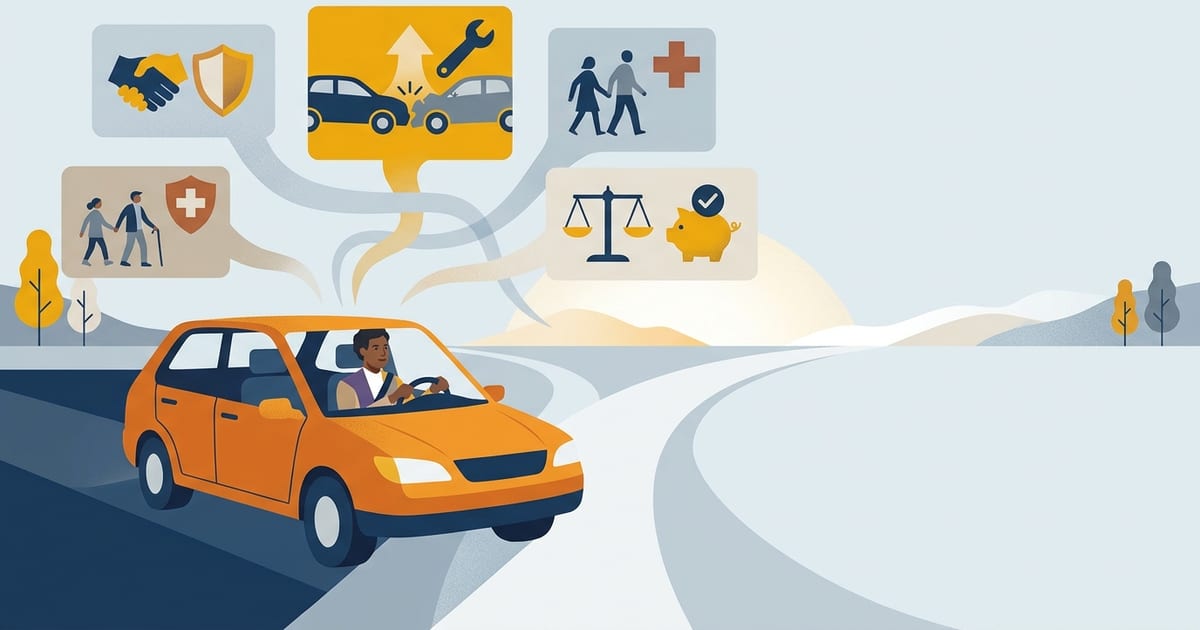
The filing requirement answers one narrow question: does this driver carry at least the legally required liability coverage? It says nothing about whether those limits would actually pay for a serious crash. State minimums in many states are 25/50/25—$25,000 per person and $50,000 per accident for injuries, $25,000 for property damage. A single hospital stay or a newer vehicle can exceed those figures. After a DUI you are, statistically, more likely to be in a serious crash than the average driver; the limits you carry are what stand between a claim and your own assets.
Liability: how much
Industry education bodies commonly suggest 100/300/100 as a reasonable target for drivers with assets or income to protect, and more if you own a home. After a DUI the marginal cost of raising liability limits is smaller than people expect, because the high-risk surcharge applies to the base premium and higher limits are priced incrementally. In Florida and Virginia the FR-44 already requires elevated limits. See how much auto coverage do I need for the general reasoning.
Collision and comprehensive: keep or drop
This is the only place where dropping coverage is sometimes right. If your car is financed or leased, the lender requires both and the question is settled. If you own it outright, compare the car's actual cash value to the annual cost of collision and comprehensive plus the deductible. A rule of thumb: if the annual premium for physical damage exceeds about ten percent of the car's value, dropping it is defensible. For most cars worth more than a few thousand dollars, keeping the coverage with a higher deductible is the better trade.
| Coverage | Keep? | Where the savings are |
|---|---|---|
| Bodily injury liability | Yes—raise it if you can | Nowhere; this is the core protection |
| Property damage liability | Yes—raise it | Nowhere |
| Uninsured/underinsured motorist | Yes, at matching limits | Nowhere; roughly one in eight drivers nationally is uninsured |
| Collision | Yes if financed or car worth > a few thousand dollars | Raise deductible to $1,000 or more |
| Comprehensive | Yes, same test | Raise deductible |
| Rental reimbursement | Optional | Drop if you have another vehicle available |
| Roadside assistance | Optional | Drop if covered elsewhere |
| Medical payments / PIP | Required in some states; otherwise useful if health coverage is thin | Choose the lower optional limit |
Uninsured motorist coverage after a DUI
Drivers focused on their own conviction often overlook that the other driver may have no insurance at all. Independent research puts the uninsured share of drivers at roughly one in eight nationally, and much higher in some states. Uninsured/underinsured motorist coverage pays for your injuries when the at-fault driver cannot. It is relatively inexpensive and, unlike most of your policy, its price is not heavily affected by your own record.
Quote finder
Find auto insurance quotes that fit your situation
Using deductibles to manage the premium
Raising your collision deductible from $500 to $1,000 typically produces a noticeable premium reduction, and the effect is proportionally larger when the base premium is high—as it is after a DUI. The condition is that you could actually pay the deductible after a crash. Set aside the difference in a savings account; if you go the surcharge period without a claim, you have both the savings and the premium reduction. The lowering rates guide covers the other levers.
Entries in this guide
Specific questions answered in more depth.
Questions & answers
Can I just carry the state minimum to satisfy my SR-22?
Legally yes. Financially it leaves you exposed if you cause a serious crash. Consider at least 50/100/50, and more if you have assets.
Does full coverage cost much more after a DUI?
The DUI surcharge applies across the policy, so collision and comprehensive are more expensive too. A higher deductible offsets much of that.
Is my lender told about my DUI?
Not by your insurer. The lender only requires that collision and comprehensive remain in force.
Terms used in this guide
- Liability coverage
- Insurance that pays for injuries and property damage you cause to others. Expressed as three limits—bodily injury per person, bodily injury per accident, property damage—such as 25/50/25 (in thousands of dollars).
- Full coverage
- Informal term for a policy that includes liability plus collision and comprehensive coverage for your own vehicle. Not a defined policy type; the limits and deductibles still vary.
- Deductible
- The amount you pay out of pocket on a collision or comprehensive claim before the insurer pays. Raising it lowers the premium—proportionally more when the base premium is high, as after a DUI.
- Uninsured/underinsured motorist coverage
- Coverage that pays for your injuries (and in some states vehicle damage) when the at-fault driver has no insurance or too little. Its price is not heavily affected by your own record.
Sources and references
Legal figures on this page (minimum limits, filing periods, statutory benefits) are checked against the primary law or the state insurance regulator listed below. Links and figures last verified Nov 2026.
- Insurance Research Council — Insurance Research CouncilIndependent researchIndependent, industry-funded research on uninsured motorists, claim trends and litigation.
- Alcohol and drugs — Insurance Institute for Highway SafetyIndependent researchImpaired-driving crash risk, BAC laws and ignition-interlock effectiveness.
- Facts + Statistics: Uninsured motorists — Insurance Information Institute (2024)Statistical dataInsurance Research Council estimates of uninsured drivers by state (2022: e.g. Michigan 19.6%, California 17.0%, Florida 15.9%, Texas 13.8%).
- Automobile financial responsibility limits by state — Insurance Information Institute (2023)Statistical dataCompulsory coverages and minimum liability limits by state (table dated December 2023 — several states have raised limits since; see statute entries).
- What is covered by a basic auto insurance policy? — Insurance Information InstituteConsumer guidanceDefines bodily injury and property damage liability, MedPay, PIP, uninsured/underinsured motorist, collision, comprehensive and glass coverage.
- How much auto coverage do I need? — Insurance Information InstituteConsumer guidanceWhy state minimums are a floor; choosing liability limits that protect assets; when collision and comprehensive are worth keeping.
- Is it legal to drive without insurance? — Insurance Information InstituteConsumer guidanceEvery state requires drivers to demonstrate financial responsibility; in most states insurance is the mandatory way to do so.
- What if I can't find auto coverage? — Insurance Information InstituteConsumer guidanceHow the non-standard market and state assigned-risk plans insure drivers the voluntary market declines.
Practical guidance on this page is original editorial work. Cited sources support factual statements and do not endorse this site. Dollar ranges described as typical or illustrative are editorial estimates, not figures from these sources.
Guide
SR-22 Insurance After a DUI
What an SR-22 is, how it differs from an FR-44, how long you need it, what it costs, and how to get one filed quickly after a DUI.
Guide
How to Lower Car Insurance After a DUI
Practical levers for reducing a high-risk premium after a DUI: comparison, deductibles, defensive-driving courses, telematics, vehicle choice and discount recovery.
Guide
How to Shop for Car Insurance After a DUI
A step-by-step method for comparing car insurance quotes after a DUI: what to have ready, which questions to ask, how to compare like with like, and when to switch.