

By Marisol Vega · Research Writer
Published · Updated
Answer in brief
An ignition interlock device (IID) is a breath-test unit wired to your car's ignition, required after a DUI in most states for first offenders and nearly all for repeat offenders. It does not directly change your insurance premium—the conviction does that—but it affects your insurance in practical ways: you must be able to insure a car to install it, a restricted licence is still a licence for insurance purposes, and completing the interlock period cleanly is part of the record insurers eventually reward.
What the device is and who needs one
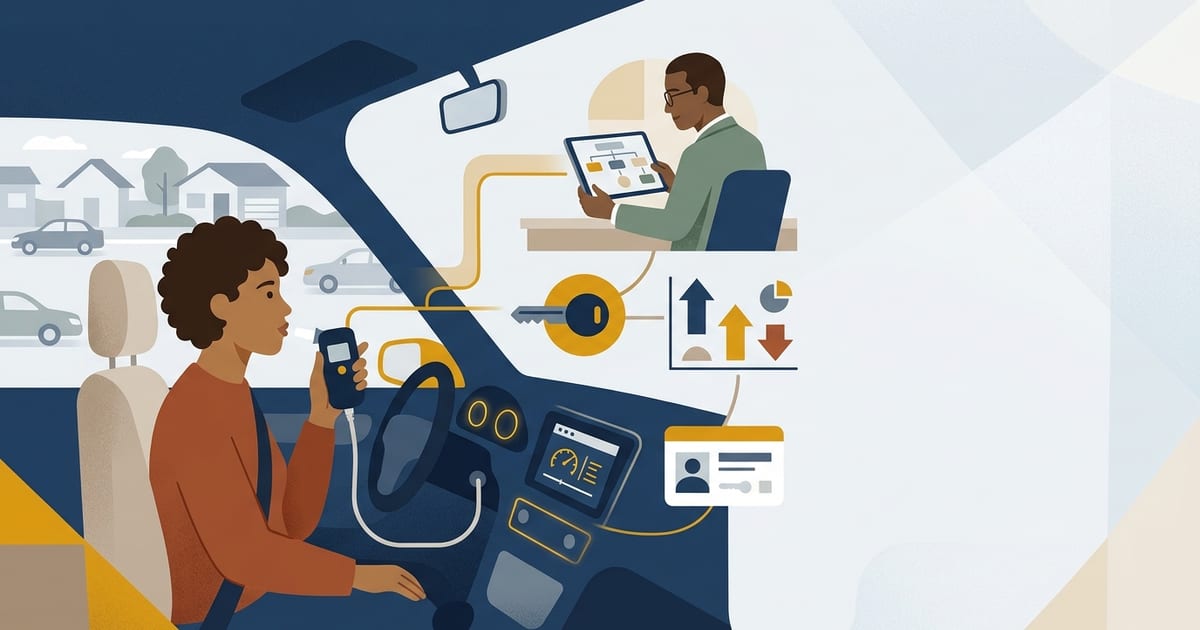
An ignition interlock requires a breath sample below a set alcohol threshold before the engine will start, and periodically while driving. Every state has an interlock law; most now require or strongly incentivise one for first offenders, and nearly all require one for repeat or high-BAC offenses. Highway-safety research associates interlock programmes with substantial reductions in repeat impaired-driving offenses while the device is installed. The requirement typically runs from several months to two years and is a condition of driving on a restricted licence.
Does an interlock affect your premium?
Not directly. Insurers rate the DUI conviction, not the device. A handful of insurers have experimented with modest discounts for interlock participants, but it is not widespread, and no insurer surcharges for having one. Where the interlock matters is indirectly: it is often a condition of having any licence at all, and a licence—even restricted—is what makes you insurable as a driver rather than as an excluded household member.
Practical interactions with insurance
- You need an insured car to install it on. Installers require proof of registration and insurance. If you do not own a car, you cannot complete an interlock requirement on a non-owner policy; you will need a vehicle titled to you or an arrangement with the owner.
- Restricted licences are licences. Insurers can and do write policies for drivers on interlock-restricted licences. Disclose the restriction when asked.
- Device costs are yours, not the insurer's. Expect an installation fee plus a monthly lease, typically in the range of $70–$150 a month, plus calibration visits. Budget for it alongside the higher premium.
- A clean interlock record is evidence. Some insurers ask about programme completion; a record with no failed tests supports your case for standard pricing when the surcharge period ends.
Who else drives the car
Everyone who drives an interlock-equipped vehicle must blow into the device, including other household members. If another driver fails a test, the event is logged against the device holder. For insurance, this is a reason to make sure every regular driver of that vehicle is listed on the policy and understands the device—an unlisted driver in a crash is a larger problem than the failed test.
Quote finder
Find auto insurance quotes that fit your situation
After the interlock period
Completing the interlock period usually leads to a full licence reinstatement. It does not end the insurance surcharge, which runs on its own schedule. Use the reinstatement as a trigger to re-compare quotes: you now have a documented period of compliant driving to point to, and some insurers weigh that in tier assignment.
Questions & answers
Do I have to tell my insurer I have an ignition interlock?
If an application asks about licence restrictions, answer truthfully. There is no surcharge for the device itself.
Can I get an insurance discount for an interlock?
A few insurers offer small discounts; most do not. Ask when you compare quotes.
Can I install an interlock on a car I don't own?
Only with the owner's consent and proof the vehicle is insured. The owner's insurer should be told that a restricted driver will use the car.
Terms used in this guide
- Ignition interlock device (IID)
- A breath-alcohol testing unit wired to a vehicle's ignition, required after a DUI in most states. It does not directly affect the insurance premium but is often a condition of holding a licence.
- DUI (Driving Under the Influence)
- A conviction for operating a vehicle while impaired by alcohol or drugs. For insurance rating it is treated as a major violation regardless of the state's label.
- High-risk driver
- An insurer's classification for a driver whose record—typically a DUI, multiple violations, at-fault accidents or a coverage lapse—predicts above-average claim costs. High-risk drivers are rated in a higher tier or placed with non-standard insurers.
Sources and references
Legal figures on this page (minimum limits, filing periods, statutory benefits) are checked against the primary law or the state insurance regulator listed below. Links and figures last verified Nov 2026.
- Alcohol and drugs — Insurance Institute for Highway SafetyIndependent researchImpaired-driving crash risk, BAC laws and ignition-interlock effectiveness.
- Trends and Insights: Auto insurance rates (June 2024) — Insurance Information Institute (2024)Independent researchWhy premiums rose 2021–2024: crash frequency and severity, repair and labour inflation, vehicle technology, attorney involvement.
- Facts + Statistics: Alcohol-impaired driving — Insurance Information InstituteStatistical dataAlcohol-impaired crash fatalities, BAC thresholds and state ignition-interlock context.
- 2019–2023 Auto Insurance Database: average premium supplement — National Association of Insurance Commissioners (2025)Statistical dataCountrywide average expenditure $1,281 in 2023 (+13.98%); combined average premium $1,438; state tables for liability, collision and comprehensive.
- Facts + Statistics: Auto insurance — Insurance Information Institute (2025)Statistical dataNAIC countrywide average auto expenditure: $1,127 (2022), $1,282 (2023); most expensive states in 2023 were Florida, Louisiana and New York.
- MADD — Mothers Against Drunk DrivingConsumer guidanceImpaired-driving prevention and victim-support resources.
- Responsibility.org — Foundation for Advancing Alcohol ResponsibilityConsumer guidanceImpaired-driving data and prevention programmes; state DUI law summaries.
- What determines the price of an auto insurance policy? — Insurance Information InstituteConsumer guidanceRating factors: driving record, mileage, location, age, gender, vehicle, credit-based insurance score, coverage choices. Notes ZIP-code rating is prohibited in California and Michigan and gender rating is prohibited in seven states.
Practical guidance on this page is original editorial work. Cited sources support factual statements and do not endorse this site. Dollar ranges described as typical or illustrative are editorial estimates, not figures from these sources.
Guide
Car Insurance After a First DUI Offense
The sequence after a first DUI: when to tell your insurer, whether to wait for renewal, what filings apply, and how to avoid the mistakes that make it worse.
Guide
Non-Owner Car Insurance After a DUI
How a non-owner policy satisfies an SR-22 or FR-44 requirement when you do not own a car, what it covers, what it costs and when it is the wrong choice.
Guide
How to Lower Car Insurance After a DUI
Practical levers for reducing a high-risk premium after a DUI: comparison, deductibles, defensive-driving courses, telematics, vehicle choice and discount recovery.