
Guide
How to Lower Car Insurance After a DUI
Practical levers for reducing a high-risk premium after a DUI: comparison, deductibles, defensive-driving courses, telematics, vehicle choice and discount recovery.

By Daniel Okafor · Senior Editor
Published · Updated
Answer in brief
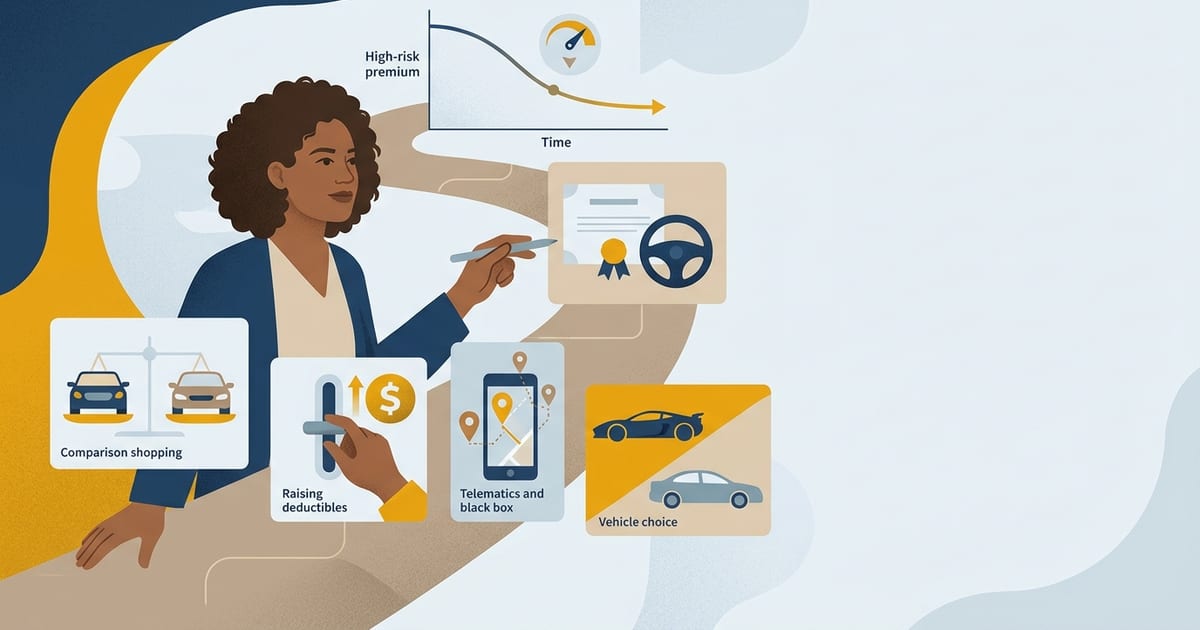
You cannot remove the DUI from your record, but you can change almost everything else that sets your premium. In rough order of impact: compare quotes from several providers, raise physical-damage deductibles, enrol in a telematics programme if you now drive carefully, complete a state-recognised defensive-driving course, recover discounts you still qualify for (multi-policy, paid-in-full, paperless), and choose the vehicle you insure with loss costs in mind. Together these commonly offset a meaningful share of the surcharge.
Start with what moves the number most
After a DUI, the single biggest lever is which company you are with. Everything else on this page adjusts the price at the margin; choosing an insurer that prices a conviction moderately changes the base. If you have not already, read the shopping guide and get three or more quotes for identical coverage. Then work through the levers below with whichever insurer comes out ahead.
Deductibles
Raising collision and comprehensive deductibles from $500 to $1,000 (or $1,000 to $2,000) produces a proportionally larger saving when your base premium is high. The saving comes with an obligation: you must be able to pay the deductible after a crash. Put the premium difference aside each month; if you reach the end of the surcharge period claim-free, you have a cushion and a lower premium. Do not reduce liability limits to save money; see coverage options for why.
Telematics and usage-based programmes
Telematics programmes use a phone app or plug-in device to measure how you drive—hard braking, speed, time of day, phone handling, mileage—and adjust your premium accordingly. For a driver whose conviction is the main negative on their record and who now drives conservatively, telematics is one of the few ways to generate positive evidence quickly. Discounts for good scores are commonly in the 10–30% range; a few programmes can raise rates for poor scores, so read the terms. Low annual mileage is rewarded in most programmes, which suits drivers who are cutting back on driving anyway.
Defensive-driving and DUI education courses
Many states allow insurers to offer a discount—often 5–10% for three years—for completing an approved defensive-driving course, and some require insurers to do so for certain drivers. The DUI education programme you may be required to complete is separate and does not usually earn an insurance discount on its own, but completing it is a reinstatement condition. Ask each insurer which courses they recognise before you pay for one; the defensive-driving discounts entry has the detail.
Discounts you can still earn
- Multi-policy: renters or homeowners insurance with the same company. Even non-standard insurers often offer it.
- Paid-in-full: avoids instalment fees, which are proportionally large on high premiums.
- Paperless and autopay: small but free.
- Vehicle safety and anti-theft: depends on the car; see below.
- Low mileage: either through telematics or a declared-mileage discount.
- Good student: if you or a listed driver qualifies.
Discounts you have probably lost—good driver, accident-free, claim-free—have their own eligibility clocks and come back on schedule. Ask when.
The vehicle you insure
Physical-damage premiums reflect the loss history of the specific make and model, published by the Highway Loss Data Institute. A modest, common, well-rated sedan or small SUV generates lower collision and comprehensive premiums than a sports model or a vehicle with high theft rates. If you are replacing a car during the surcharge period, checking loss data before you buy is worth an hour.
Quote finder
Find auto insurance quotes that fit your situation
What does not work
- Letting coverage lapse to "wait it out". It adds a lapse factor and restarts filing clocks.
- Omitting the conviction on an application. The record is pulled anyway, and misrepresentation can void coverage.
- Registering the car to someone else to avoid the rate. This is misrepresentation of the principal driver and a common cause of denied claims.
Entries in this guide
Specific questions answered in more depth.
Entry
Defensive-Driving Course Discounts After a DUI
Which courses earn an insurance discount, how much, for how long, how they differ from mandatory DUI education programmes, and how to confirm eligibility before you pay.
Entry
Telematics Programmes After a DUI: Do They Help?
How usage-based insurance programmes score driving, which behaviours they reward and penalise, and when enrolling after a DUI is a good or bad idea.
Questions & answers
Can I get a discount for completing my DUI programme?
Rarely on its own. A separate state-approved defensive-driving course is more likely to earn a discount. Ask the insurer which courses they recognise.
Is telematics a good idea after a DUI?
If you now drive carefully and not at late-night hours, usually yes; it generates positive evidence quickly. Check whether the programme can raise rates for poor scores.
How much can these steps save in total?
It varies, but comparison plus a higher deductible plus a telematics discount commonly offsets a substantial fraction of the surcharge for drivers who qualify.
Terms used in this guide
- Deductible
- The amount you pay out of pocket on a collision or comprehensive claim before the insurer pays. Raising it lowers the premium—proportionally more when the base premium is high, as after a DUI.
- Surcharge
- A percentage added to a premium for a specific violation or accident, applied for a set period—commonly three years for a DUI.
- Non-standard insurance
- The segment of the auto insurance market that specialises in drivers standard insurers decline or price steeply, including drivers with a DUI. Non-standard insurers routinely provide SR-22 filings.
- Full coverage
- Informal term for a policy that includes liability plus collision and comprehensive coverage for your own vehicle. Not a defined policy type; the limits and deductibles still vary.
Sources and references
Legal figures on this page (minimum limits, filing periods, statutory benefits) are checked against the primary law or the state insurance regulator listed below. Links and figures last verified Nov 2026.
- Background on: Pay-as-you-drive auto insurance (telematics) — Insurance Information InstituteIndependent researchUsage-based and per-mile pricing models, what telematics programmes measure, and state limits on their use.
- Alcohol and drugs — Insurance Institute for Highway SafetyIndependent researchImpaired-driving crash risk, BAC laws and ignition-interlock effectiveness.
- Insurance losses by make and model — Highway Loss Data InstituteStatistical dataRelative claim frequency and severity by vehicle under collision, property damage, comprehensive, PIP, MedPay and bodily injury coverages.
- Facts + Statistics: Alcohol-impaired driving — Insurance Information InstituteStatistical dataAlcohol-impaired crash fatalities, BAC thresholds and state ignition-interlock context.
- Vehicle ratings — Insurance Institute for Highway SafetyStatistical dataCrashworthiness and crash-avoidance ratings by make and model.
- Nine ways to lower your auto insurance costs — Insurance Information InstituteConsumer guidanceShop at least three quotes; raising a deductible from $200 to $500 can cut collision/comprehensive cost 15–30%, $1,000 can save 40%+; drop physical damage on cars worth under 10× the premium; bundling, low-mileage and good-student discounts.
- What determines the price of an auto insurance policy? — Insurance Information InstituteConsumer guidanceRating factors: driving record, mileage, location, age, gender, vehicle, credit-based insurance score, coverage choices. Notes ZIP-code rating is prohibited in California and Michigan and gender rating is prohibited in seven states.
- Responsibility.org — Foundation for Advancing Alcohol ResponsibilityConsumer guidanceImpaired-driving data and prevention programmes; state DUI law summaries.
Practical guidance on this page is original editorial work. Cited sources support factual statements and do not endorse this site. Dollar ranges described as typical or illustrative are editorial estimates, not figures from these sources.
Guide
How to Shop for Car Insurance After a DUI
A step-by-step method for comparing car insurance quotes after a DUI: what to have ready, which questions to ask, how to compare like with like, and when to switch.
Guide
What Car Insurance Coverage to Buy After a DUI
Liability limits, collision and comprehensive, uninsured motorist and medical coverage after a DUI: what a filing requires, what you should actually carry, and where to save without exposing yourself.
Guide
How Long a DUI Affects Car Insurance
Lookback periods, surcharge windows and state record rules that decide how many years a DUI raises your premium, and when rates start to come down.