

By Daniel Okafor · Senior Editor
Published · Updated
Answer in brief
A nonrenewal is a notice that your insurer will not offer a new policy term when the current one ends. After a DUI it usually means the company does not write high-risk business, not that you are uninsurable. State law typically requires 30–60 days' notice. It differs from a cancellation, which ends coverage mid-term and is restricted by law to specific reasons. The response is practical: start comparing quotes the day the notice arrives, bind a new policy before the end date, and make sure any filing moves with you.
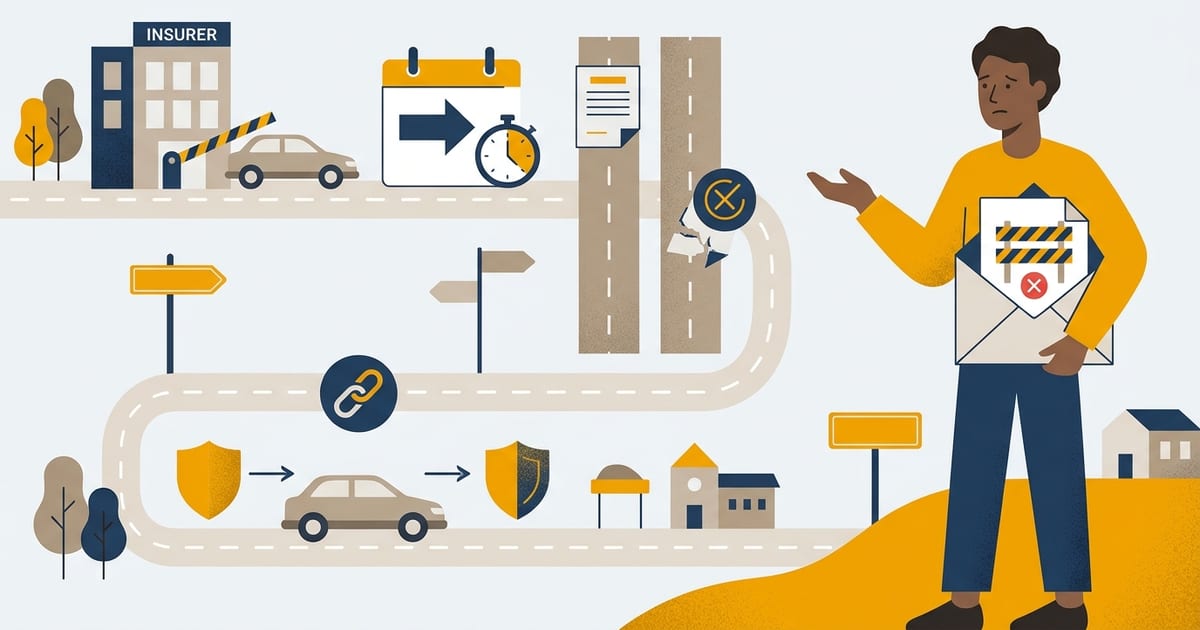
Nonrenewal versus cancellation
The two are legally distinct. A cancellation ends a policy during its term and, after the first 60 days or so, is usually limited by state law to specific grounds—nonpayment, licence suspension, material misrepresentation. A DUI conviction is not usually a permitted mid-term cancellation reason on its own, although the licence suspension that accompanies it can be. A nonrenewal happens at the end of the term; insurers have much wider latitude to decline to renew, and a DUI is a common reason. Both require written notice, with timing set by state law.
Why companies nonrenew after a DUI
Insurers specialise. Companies that compete for preferred and standard drivers often have underwriting rules that exclude major violations, because their pricing is built around a lower-risk population. Companies that specialise in non-standard business are built to price higher risk. A nonrenewal after a DUI is most often the first type of company telling you that you now belong with the second type. It is not a judgment about whether you can be insured; the non-standard market exists for exactly this situation.
What the notice should contain
- The date coverage ends.
- The reason, in states that require one.
- Notice period that meets your state's minimum—commonly 30, 45 or 60 days before expiry.
- If you have an SR-22 or FR-44 filing, the insurer will also notify the state when the policy ends. Your new insurer's filing must be in place before that date.
What to do, in order
- 1
Note the end date and work backwards
You want the new policy bound at least a week before, with the new filing confirmed.
- 2
Ask the current insurer whether an affiliate will write you
Many insurance groups have a non-standard affiliate. Sometimes the nonrenewal notice is accompanied by an offer from one; sometimes you have to ask.
- 3
Compare at least three quotes
Lead with the conviction and the filing requirement. See the shopping guide.
- 4
Bind, confirm the filing, then let the old policy expire
Do not cancel the old policy early unless the new one is active; a one-day gap is a lapse.
- 5
Keep the nonrenewal notice
Some new insurers ask whether you were nonrenewed and why. The letter answers both.
Quote finder
Find auto insurance quotes that fit your situation
Does a nonrenewal itself hurt future rates?
Applications sometimes ask whether you have been cancelled or nonrenewed. Being honest about a nonrenewal for a DUI does not add much, because the insurer will rate the DUI anyway. A lapse in coverage, on the other hand, is a separate rating factor in most states, which is why the timing above matters more than the nonrenewal itself.
Questions & answers
Can my insurer cancel me mid-policy for a DUI?
Usually not for the conviction alone, but a licence suspension that accompanies it may be a permitted ground in your state. Read the cancellation section of your policy.
How long do I have after a nonrenewal notice?
State law sets the minimum, commonly 30–60 days before the policy ends. Start comparing the day the notice arrives.
Will I have trouble finding another insurer?
Non-standard insurers write DUI risks routinely. The premium will be higher; availability is rarely the issue.
Terms used in this guide
- Nonrenewal
- An insurer's decision not to offer a new policy term when the current one ends. Distinct from cancellation, which ends coverage mid-term. A DUI is a common reason for nonrenewal by insurers that do not write high-risk business.
- High-risk driver
- An insurer's classification for a driver whose record—typically a DUI, multiple violations, at-fault accidents or a coverage lapse—predicts above-average claim costs. High-risk drivers are rated in a higher tier or placed with non-standard insurers.
- Non-standard insurance
- The segment of the auto insurance market that specialises in drivers standard insurers decline or price steeply, including drivers with a DUI. Non-standard insurers routinely provide SR-22 filings.
- SR-22
- A certificate of financial responsibility that an insurer files with a state to prove a driver carries at least the minimum required liability coverage. Required after a DUI in most states, usually for three years.
Sources and references
Legal figures on this page (minimum limits, filing periods, statutory benefits) are checked against the primary law or the state insurance regulator listed below. Links and figures last verified Nov 2026.
- Alcohol and drugs — Insurance Institute for Highway SafetyIndependent researchImpaired-driving crash risk, BAC laws and ignition-interlock effectiveness.
- Facts + Statistics: Alcohol-impaired driving — Insurance Information InstituteStatistical dataAlcohol-impaired crash fatalities, BAC thresholds and state ignition-interlock context.
- Consumer insurance information — National Association of Insurance CommissionersConsumer guidancePlain-language guides from the body of state insurance regulators; links to every state's insurance department and complaint process.
- Buying tips — United PolicyholdersConsumer guidanceNon-profit guidance on choosing coverage, deductibles and limits, and on handling claims.
- What determines the price of an auto insurance policy? — Insurance Information InstituteConsumer guidanceRating factors: driving record, mileage, location, age, gender, vehicle, credit-based insurance score, coverage choices. Notes ZIP-code rating is prohibited in California and Michigan and gender rating is prohibited in seven states.
- Responsibility.org — Foundation for Advancing Alcohol ResponsibilityConsumer guidanceImpaired-driving data and prevention programmes; state DUI law summaries.
- What if I can't find auto coverage? — Insurance Information InstituteConsumer guidanceHow the non-standard market and state assigned-risk plans insure drivers the voluntary market declines.
- Is it legal to drive without insurance? — Insurance Information InstituteConsumer guidanceEvery state requires drivers to demonstrate financial responsibility; in most states insurance is the mandatory way to do so.
Practical guidance on this page is original editorial work. Cited sources support factual statements and do not endorse this site. Dollar ranges described as typical or illustrative are editorial estimates, not figures from these sources.
Guide
Car Insurance After a First DUI Offense
The sequence after a first DUI: when to tell your insurer, whether to wait for renewal, what filings apply, and how to avoid the mistakes that make it worse.
Guide
How to Shop for Car Insurance After a DUI
A step-by-step method for comparing car insurance quotes after a DUI: what to have ready, which questions to ask, how to compare like with like, and when to switch.
Guide
SR-22 Insurance After a DUI
What an SR-22 is, how it differs from an FR-44, how long you need it, what it costs, and how to get one filed quickly after a DUI.