
Entry in SR-22 Insurance After a DUI
What Happens If Your SR-22 Lapses After a DUI? Penalties and Solutions
Learn what happens when an SR-22 certificate lapses after a DUI, how insurers notify state agencies, and the concrete steps required to reinstate your license.

By Daniel Okafor · Senior Editor
Published
Answer in brief
If your SR-22 insurance policy lapses due to non-payment or cancellation, your insurance carrier is legally required to notify your state licensing agency via an SR-26 form. This notification triggers an immediate suspension of your driving privileges. In many jurisdictions, such as Texas under 37 TAC § 25.5, a lapse resets the mandatory filing clock, requiring you to secure a replacement policy and pay state reinstatement fees before you can lawfully drive again.
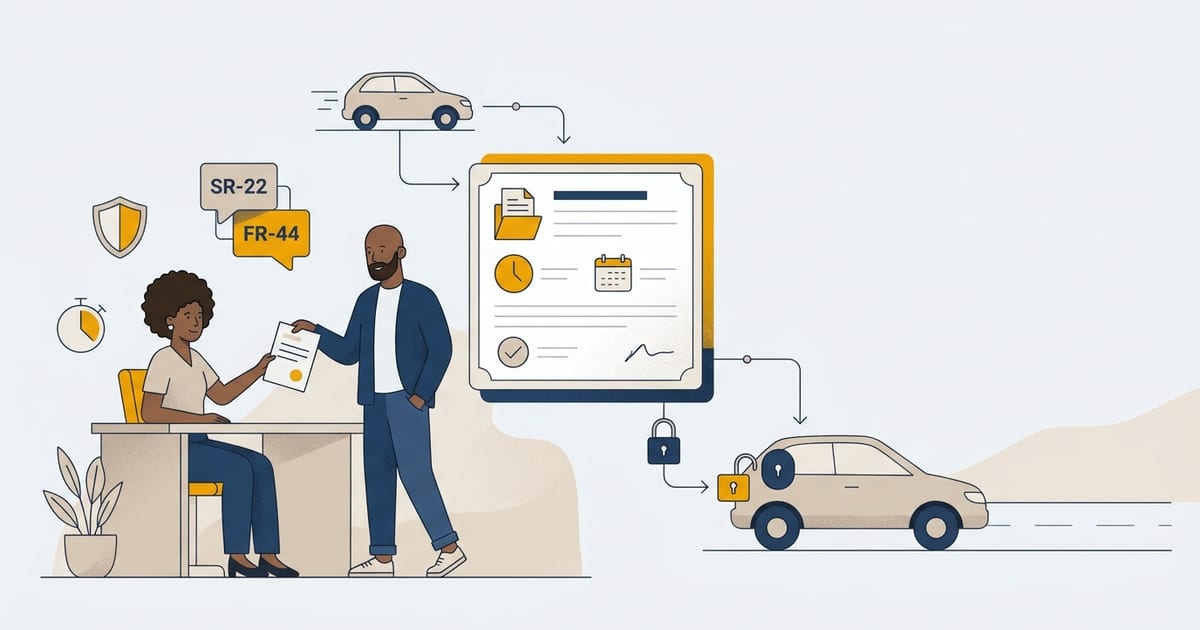
The Immediate Chain Reaction of an SR-22 Lapse
An SR-22 is not an insurance policy on its own; it is a state-mandated certificate of financial responsibility that an auto insurer attaches to an underlying policy. When you maintain an active policy with this certificate, the carrier vouches to your state licensing agency that you carry the required liability coverage. However, this agreement functions in both directions. The moment your coverage terminates—whether through missed payments, policy cancellation, or carrier nonrenewal—the insurer is statutorily compelled to notify the state immediately.
This formal notification is commonly transmitted electronically using an SR-26 cancellation form. The SR-26 alerts state regulators that the certificate holder is no longer maintaining compliant coverage. Because continuous proof of financial responsibility is a legal condition of maintaining or reinstating a driver's license following a DUI conviction, receipt of an SR-26 initiates an administrative suspension of driving privileges. Unlike an ordinary lapse where an uninsured motorist might drive undetected until an inspection or crash report, an SR-22 lapse is reported directly to state licensing authorities in real time.
| Lapse Stage | Action Taken by Insurer / State | Impact on the Driver |
|---|---|---|
| Missed Payment / Cancellation | Carrier issues policy termination and generates an SR-26 filing. | Loss of underlying liability coverage and active financial responsibility. |
| State Agency Processing | State licensing agency processes the SR-26 form automatically. | Driving privileges are immediately revoked or suspended; notification mailed. |
| Filing Timeline Reset | State evaluates statutory compliance duration. | Mandatory filing period often restarts from day zero, wiping out accumulated time. |
| Reinstatement Requirements | Agency demands new certificate plus administrative fees. | Must purchase a new policy, pay filing and license reinstatement penalties. |
How State Regulations Enforce Filing Lapses
Every state establishes clear legal obligations for drivers required to demonstrate financial responsibility. When that status lapses, administrative consequences are swift and uncompromising. Under Texas Administrative Code (37 TAC § 25.5), for instance, an SR-22 filed as compliance must be maintained continuously for two years from the most recent qualifying conviction. The administrative code explicitly dictates that a lapse re-suspends driving privileges until a new certificate is filed. In multiple jurisdictions, any gap in coverage resets your statutory clock, meaning months or years of prior compliance are erased, forcing you to begin the entire mandate period from scratch.
Furthermore, allowing a policy with an SR-22 to lapse signals severe administrative risk to underwriters. When you seek replacement coverage, voluntary carriers may classify you as a severe risk, applying a higher surcharge or declining coverage outright. This frequently pushes drivers into the non-standard insurance market, where baseline rates are substantially higher than typical market averages.
Why SR-22 Policies Lapse and How to Protect Your Record
The primary cause of an SR-22 lapse is premium non-payment. After an impaired-driving conviction, drivers experience substantial rate increases, often paying hundreds or thousands of dollars above standard baseline rates. According to the National Association of Insurance Commissioners (NAIC), the countrywide average expenditure for personal auto insurance was $1,281 in 2023, reflecting a 13.98% annual increase across all drivers. For individuals requiring an SR-22 insurance after a DUI, premiums can be multiples of that benchmark, causing budget strain that leads to missed installments.
A second common cause is carrier nonrenewal. Some voluntary carriers do not renew policies once an impaired-driving conviction surfaces at renewal underwriting. If an insured driver fails to secure a replacement carrier before the existing policy expiration date, an administrative lapse occurs automatically. To avoid this scenario, drivers who receive nonrenewal notices should immediately research options for non-owner car insurance after a DUI or seek quotes from specialized carriers that file certificates electronically.
Step-by-Step: How to Reinstate Your Privileges After an SR-22 Lapse
- 1
1. Confirm Your Exact License and Filing Status
Access your driving record through your state licensing agency portal. Verify whether an SR-26 has been logged, determine if your driving privileges are suspended, and confirm whether your mandatory compliance timeline has been reset.
- 2
2. Secure a Compliant Insurance Policy
Obtain coverage that satisfies your state's mandated liability thresholds. If you do not own a vehicle, purchase a non-owner policy to satisfy the certificate requirement economically. Request that the insurer attach an SR-22 endorsement immediately.
- 3
3. Ensure Electronic Certificate Transmission
Verify that your insurer submits the SR-22 filing directly to your state licensing department via secure electronic data transfer. Obtain a copy of the certificate and confirmation receipt for your personal records.
- 4
4. Pay State Administrative Reinstatement Fees
Pay all required license reinstatement penalties demanded by your state agency. Driving privileges remain legally suspended until the state processes your new filing and clears your administrative record.
If standard carriers decline your application due to a recent lapse or impaired-driving conviction, you are not entirely without options. As detailed by the Insurance Information Institute, drivers unable to find coverage in the voluntary market can access the non-standard market or state assigned-risk plans (automobile insurance plans) to secure the mandatory financial responsibility required by state law. Setting up recurring automatic electronic payments is the most reliable way to ensure you never experience another lapse throughout your mandated SR-22 filing duration.
Questions & answers
Does an SR-22 lapse automatically reset my mandatory filing period?
In many states, yes. Regulatory statutes often mandate continuous, uninterrupted proof of financial responsibility. For example, in jurisdictions like Texas under 37 TAC § 25.5, a lapse requires re-establishing compliance, and state licensing agencies frequently reset the required time period back to day one.
What is an SR-26 form?
An SR-26 is a formal document submitted by an auto insurer to a state licensing agency notifying regulators that an SR-22 financial responsibility certificate has been cancelled, lapsed, or nonrenewed.
Can I satisfy an SR-22 requirement if I no longer own a vehicle?
Yes. Drivers who do not own a vehicle can purchase an operator's or non-owner policy with an SR-22 endorsement. This satisfies the state's financial responsibility requirement and keeps your filing compliance active without paying for physical damage coverage on a car.
How quickly does the state suspend a license after a missed insurance payment?
Insurers notify the state licensing agency as soon as policy cancellation takes effect. Depending on state processing speeds, the suspension is typically logged within days of receiving the electronic SR-26 notification.
Terms: SR-22, Financial responsibility, High-risk driver, Non-standard insurance, Surcharge
Sources and references
Legal figures on this page (minimum limits, filing periods, statutory benefits) are checked against the primary law or the state insurance regulator listed below. Links and figures last verified Nov 2026.
- 37 TAC § 25.5 — enforcement of failure to maintain financial responsibility — Texas Administrative Code (via Cornell LII), 37 Tex. Admin. Code § 25.5Primary lawAn SR-22 filed as compliance must be maintained for two years from the most recent qualifying conviction; a lapse re-suspends driving privileges until a new certificate is filed.
- Alcohol and drugs — Insurance Institute for Highway SafetyIndependent researchImpaired-driving crash risk, BAC laws and ignition-interlock effectiveness.
- 2019–2023 Auto Insurance Database: average premium supplement — National Association of Insurance Commissioners (2025)Statistical dataCountrywide average expenditure $1,281 in 2023 (+13.98%); combined average premium $1,438; state tables for liability, collision and comprehensive.
- Facts + Statistics: Alcohol-impaired driving — Insurance Information InstituteStatistical dataAlcohol-impaired crash fatalities, BAC thresholds and state ignition-interlock context.
- Is it legal to drive without insurance? — Insurance Information InstituteConsumer guidanceEvery state requires drivers to demonstrate financial responsibility; in most states insurance is the mandatory way to do so.
- What if I can't find auto coverage? — Insurance Information InstituteConsumer guidanceHow the non-standard market and state assigned-risk plans insure drivers the voluntary market declines.
- What determines the price of an auto insurance policy? — Insurance Information InstituteConsumer guidanceRating factors: driving record, mileage, location, age, gender, vehicle, credit-based insurance score, coverage choices. Notes ZIP-code rating is prohibited in California and Michigan and gender rating is prohibited in seven states.
- Responsibility.org — Foundation for Advancing Alcohol ResponsibilityConsumer guidanceImpaired-driving data and prevention programmes; state DUI law summaries.
Practical guidance on this page is original editorial work. Cited sources support factual statements and do not endorse this site. Dollar ranges described as typical or illustrative are editorial estimates, not figures from these sources.
Entry
FR-44 Insurance in Florida and Virginia After a DUI
How the FR-44 differs from an SR-22, the higher liability limits it requires in Florida and Virginia, and what that does to the cost of car insurance after a DUI.
Entry
How Long You Need an SR-22 After a DUI
Typical SR-22 durations after a DUI, when the clock starts, what resets it, and how to confirm the requirement has ended before you drop the filing.
Entry
How Much an SR-22 Costs After a DUI
Separating the SR-22 filing fee from the high-risk premium and the state reinstatement fee, with typical ranges for each and where the real savings are.
Parent guide
SR-22 Insurance After a DUI
What an SR-22 is, how it differs from an FR-44, how long you need it, what it costs, and how to get one filed quickly after a DUI.