

By Marisol Vega · Research Writer
Published · Updated
Answer in brief
A state-approved defensive-driving or driver-improvement course commonly earns a 5–10% discount for three years with insurers that recognise it, and some states require insurers to offer it to certain drivers. The DUI education programme you may be ordered to complete is a different thing: it is a reinstatement condition and rarely earns a discount by itself. Confirm with your insurer which specific course they accept before paying for one.
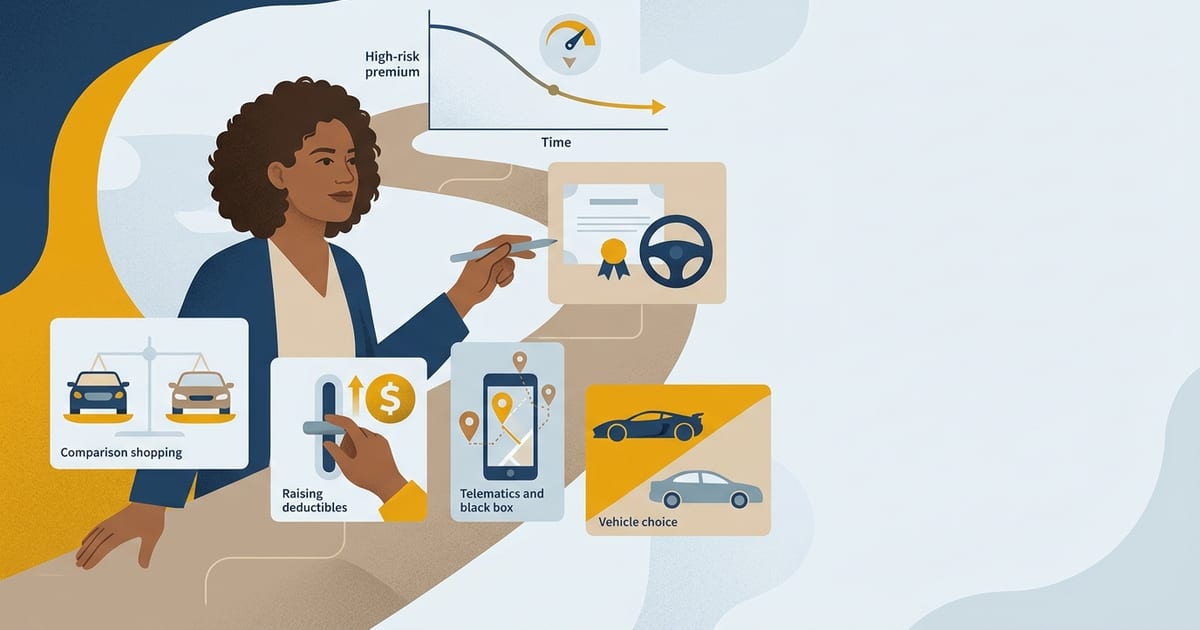
Two kinds of course
| Defensive-driving / driver-improvement course | DUI education or treatment programme | |
|---|---|---|
| Who requires it | Voluntary (sometimes court-offered to dismiss a ticket) | Court or licensing agency as a condition of reinstatement |
| Length | Typically 4–8 hours, often online | From a one-day class to multi-month programmes |
| Insurance effect | Discount with recognising insurers, commonly 5–10% for 3 years | Usually none directly; completion is a reinstatement condition |
| Cost | Roughly $20–$100 | Varies widely; often several hundred dollars or more |
Where the discount is strongest
Some states require insurers to provide a discount for completing an approved course—most often for drivers over a certain age (mature-driver courses) and in a few states for all drivers. Elsewhere it is at the insurer's discretion. Non-standard insurers vary: some offer the discount, some do not. Ask every insurer you compare whether a course discount is available and which providers qualify.
How to make sure it counts
- 1
Ask the insurer first
Get the names of accepted course providers in writing.
- 2
Take the course and keep the certificate
Insurers usually require a completion certificate with a date.
- 3
Submit it and confirm the discount appears
Check the next declarations page.
- 4
Note the expiry
Most course discounts last three years and can be renewed by retaking the course.
Quote finder
Find auto insurance quotes that fit your situation
Stacking with other levers
A course discount is modest on its own. It is worthwhile because it stacks with telematics, higher deductibles and multi-policy discounts, and because it costs little. See lowering rates after a DUI for the full set.
Questions & answers
Will my court-ordered DUI class lower my insurance?
Rarely by itself. A separate approved defensive-driving course is more likely to earn a discount.
Can I take the course online?
Most approved courses are available online. Confirm the specific provider is accepted by your insurer.
Terms: Surcharge, Deductible
Sources and references
Legal figures on this page (minimum limits, filing periods, statutory benefits) are checked against the primary law or the state insurance regulator listed below. Links and figures last verified Nov 2026.
- Fla. Stat. § 324.023 — financial responsibility after a DUI conviction — Florida Legislature (Online Sunshine), Fla. Stat. § 324.023Primary lawAfter a DUI conviction (since 1 Oct 2007): $100,000 per person / $300,000 per crash bodily injury and $50,000 property damage, maintained for three years from reinstatement — the FR-44 requirement.
- Va. Code § 46.2-316 — proof of financial responsibility after certain convictions — Virginia Law (LIS), Va. Code § 46.2-316(C)Primary lawAfter DUI-type convictions, proof must be at double the § 46.2-472 limits (the FR-44 requirement, currently 100/200/50) for three years after becoming eligible for a licence.
- Alcohol and drugs — Insurance Institute for Highway SafetyIndependent researchImpaired-driving crash risk, BAC laws and ignition-interlock effectiveness.
- Facts + Statistics: Alcohol-impaired driving — Insurance Information InstituteStatistical dataAlcohol-impaired crash fatalities, BAC thresholds and state ignition-interlock context.
- Nine ways to lower your auto insurance costs — Insurance Information InstituteConsumer guidanceShop at least three quotes; raising a deductible from $200 to $500 can cut collision/comprehensive cost 15–30%, $1,000 can save 40%+; drop physical damage on cars worth under 10× the premium; bundling, low-mileage and good-student discounts.
- Consumer insurance information — National Association of Insurance CommissionersConsumer guidancePlain-language guides from the body of state insurance regulators; links to every state's insurance department and complaint process.
- Responsibility.org — Foundation for Advancing Alcohol ResponsibilityConsumer guidanceImpaired-driving data and prevention programmes; state DUI law summaries.
- What determines the price of an auto insurance policy? — Insurance Information InstituteConsumer guidanceRating factors: driving record, mileage, location, age, gender, vehicle, credit-based insurance score, coverage choices. Notes ZIP-code rating is prohibited in California and Michigan and gender rating is prohibited in seven states.
Practical guidance on this page is original editorial work. Cited sources support factual statements and do not endorse this site. Dollar ranges described as typical or illustrative are editorial estimates, not figures from these sources.
Entry
Telematics Programmes After a DUI: Do They Help?
How usage-based insurance programmes score driving, which behaviours they reward and penalise, and when enrolling after a DUI is a good or bad idea.
Parent guide
How to Lower Car Insurance After a DUI
Practical levers for reducing a high-risk premium after a DUI: comparison, deductibles, defensive-driving courses, telematics, vehicle choice and discount recovery.