

By Daniel Okafor · Senior Editor
Published · Updated
Answer in brief
Telematics programmes score how you actually drive—braking, speed, time of day, phone use and mileage—and adjust your premium accordingly. After a DUI they are one of the few ways to generate positive evidence quickly. For a driver who now drives conservatively and rarely at night, enrolling usually helps, with discounts commonly in the 10–30% range. For a driver who still drives late, hard or a lot, it can backfire with programmes that raise rates for poor scores.
What the programmes measure
- Hard braking and rapid acceleration — frequency per 100 miles.
- Speed — relative to limits and in absolute terms.
- Time of day — late-night driving is penalised in most programmes.
- Phone handling — app-based programmes detect handheld use while moving.
- Mileage — lower is better; some programmes are primarily per-mile.
Why they suit some post-DUI drivers
Rating from your record is backward-looking; the conviction will sit there for years. Telematics is forward-looking and updates every few months. A driver who has genuinely changed their habits—no late-night driving, steady speeds, lower mileage—can demonstrate it in a single policy term rather than waiting for the lookback period to expire. Low-mileage pricing in particular rewards drivers who are cutting back, which many do after a conviction.
When to be cautious
Read whether the programme is discount-only or can raise your rate. Discount-only programmes are low-risk: the worst case is no discount. Two-way programmes can surcharge poor scores, which stacks on a DUI surcharge. If your work requires late-night driving or high mileage, a two-way programme may cost you. Also consider privacy: the insurer sees location and time data, and in a few states telematics data has been requested in legal proceedings.
Quote finder
Find auto insurance quotes that fit your situation
Getting the most from it
- 1
Choose a discount-only programme if available
Ask explicitly whether scores can increase your premium.
- 2
Drive for the score in the first 90 days
Most programmes set the discount from an initial monitoring period.
- 3
Mount the phone and leave it alone
Phone handling is the most common score killer.
- 4
Avoid the midnight–4 a.m. window
It is weighted heavily in almost every programme.
Questions & answers
Can a telematics programme raise my rate after a DUI?
Some two-way programmes can. Choose a discount-only programme if your driving is unpredictable.
How quickly does the discount apply?
Typically after an initial monitoring period of 60–180 days, then adjusted at renewal.
Terms: Surcharge, High-risk driver
Sources and references
Legal figures on this page (minimum limits, filing periods, statutory benefits) are checked against the primary law or the state insurance regulator listed below. Links and figures last verified Nov 2026.
- Background on: Pay-as-you-drive auto insurance (telematics) — Insurance Information InstituteIndependent researchUsage-based and per-mile pricing models, what telematics programmes measure, and state limits on their use.
- Alcohol and drugs — Insurance Institute for Highway SafetyIndependent researchImpaired-driving crash risk, BAC laws and ignition-interlock effectiveness.
- Facts + Statistics: Alcohol-impaired driving — Insurance Information InstituteStatistical dataAlcohol-impaired crash fatalities, BAC thresholds and state ignition-interlock context.
- Nine ways to lower your auto insurance costs — Insurance Information InstituteConsumer guidanceShop at least three quotes; raising a deductible from $200 to $500 can cut collision/comprehensive cost 15–30%, $1,000 can save 40%+; drop physical damage on cars worth under 10× the premium; bundling, low-mileage and good-student discounts.
- Responsibility.org — Foundation for Advancing Alcohol ResponsibilityConsumer guidanceImpaired-driving data and prevention programmes; state DUI law summaries.
- What determines the price of an auto insurance policy? — Insurance Information InstituteConsumer guidanceRating factors: driving record, mileage, location, age, gender, vehicle, credit-based insurance score, coverage choices. Notes ZIP-code rating is prohibited in California and Michigan and gender rating is prohibited in seven states.
- What if I can't find auto coverage? — Insurance Information InstituteConsumer guidanceHow the non-standard market and state assigned-risk plans insure drivers the voluntary market declines.
- Is it legal to drive without insurance? — Insurance Information InstituteConsumer guidanceEvery state requires drivers to demonstrate financial responsibility; in most states insurance is the mandatory way to do so.
Practical guidance on this page is original editorial work. Cited sources support factual statements and do not endorse this site. Dollar ranges described as typical or illustrative are editorial estimates, not figures from these sources.
Entry
Defensive-Driving Course Discounts After a DUI
Which courses earn an insurance discount, how much, for how long, how they differ from mandatory DUI education programmes, and how to confirm eligibility before you pay.
Parent guide
How to Lower Car Insurance After a DUI
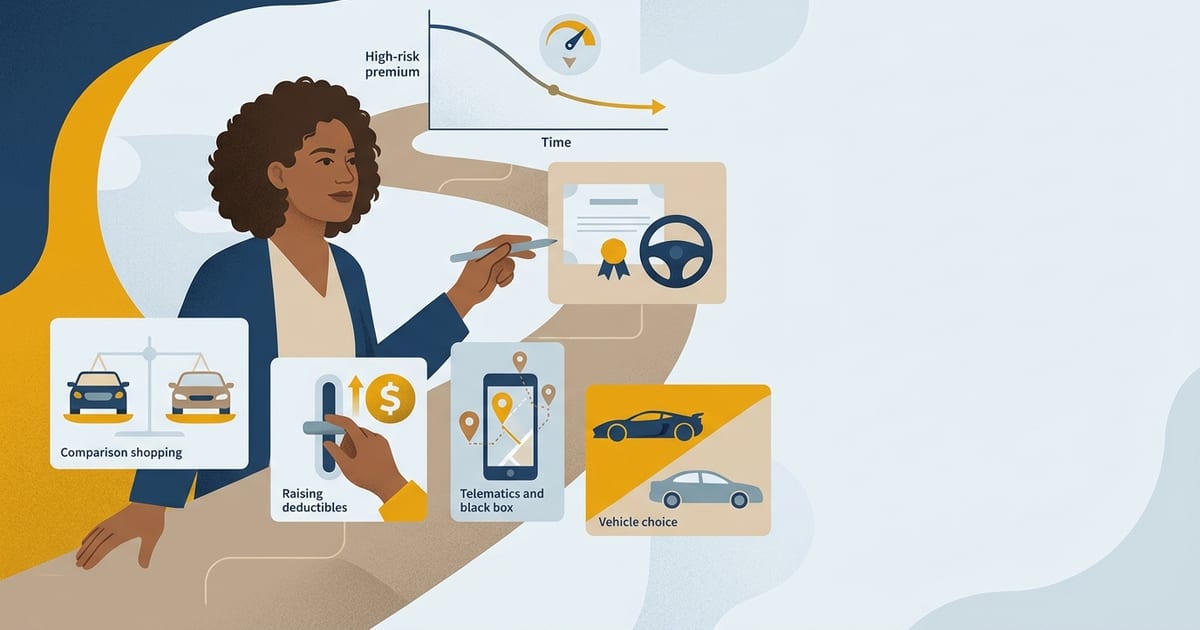
Practical levers for reducing a high-risk premium after a DUI: comparison, deductibles, defensive-driving courses, telematics, vehicle choice and discount recovery.